How much does a good welding table cost? This is one of the first questions that arises when planning the purchase of a new welding station. There is no single answer. The price of a welding table can vary considerably depending on its dimensions, construction, material, clamping system, equipment and scope for future expansion.
When comparing welding-table prices, it is worth looking beyond the purchase price. A table is a tool that can serve a company for many years and directly affect the time required to prepare components, positioning accuracy, production repeatability and working comfort.
Instead of asking only ‘How much does a welding table cost?’, it is therefore worth asking another question: ‘What do I receive for this price, and how will the solution affect my day-to-day work?’
What determines the price of a welding table?
The market offers everything from simple tables intended for occasional welding to advanced systems used in professional production plants. Prices can differ significantly because the term ‘welding table’ covers structures with very different capabilities.
The main factors affecting the price are:
– the size of the working area,
– the thickness and type of material used for the tabletop,
– manufacturing accuracy and surface flatness,
– the hole and clamping system,
– surface resistance to wear and welding spatter,
– the leg and underframe design,
– height-adjustment capability,
– the number and type of accessories,
– the ability to expand the table or change its configuration,
– the workstation’s intended use.
In practice, two tables with similar dimensions may belong to entirely different classes.
How much does a professional welding table cost?
The price of a professional workstation depends primarily on its configuration. For CUBEWELD, examples of complete sets available from the shop show how the cost changes with the size of the working area and the included equipment.
For example:
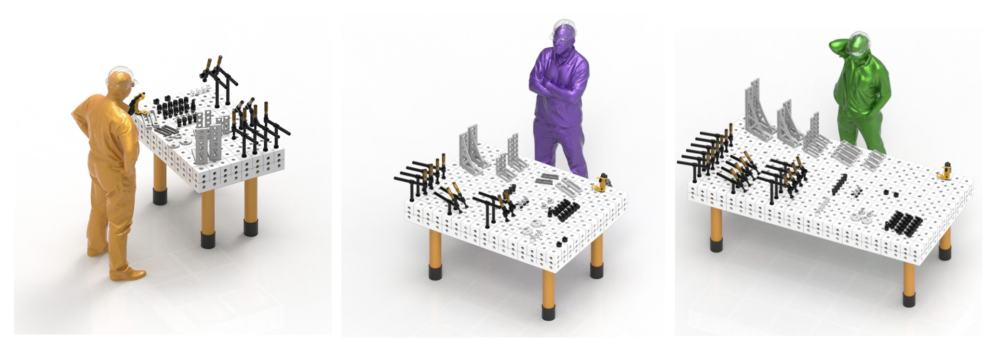
CUBEWELD ULTIMATE 28 1200 × 800 mm + Tool Kit 1 – PLN 21,605 net
This compact configuration is intended for smaller components and workstations where space is limited, among other applications.
CUBEWELD ULTIMATE 28 1600 × 1200 mm + Tool Kit 1 – PLN 31,599 net
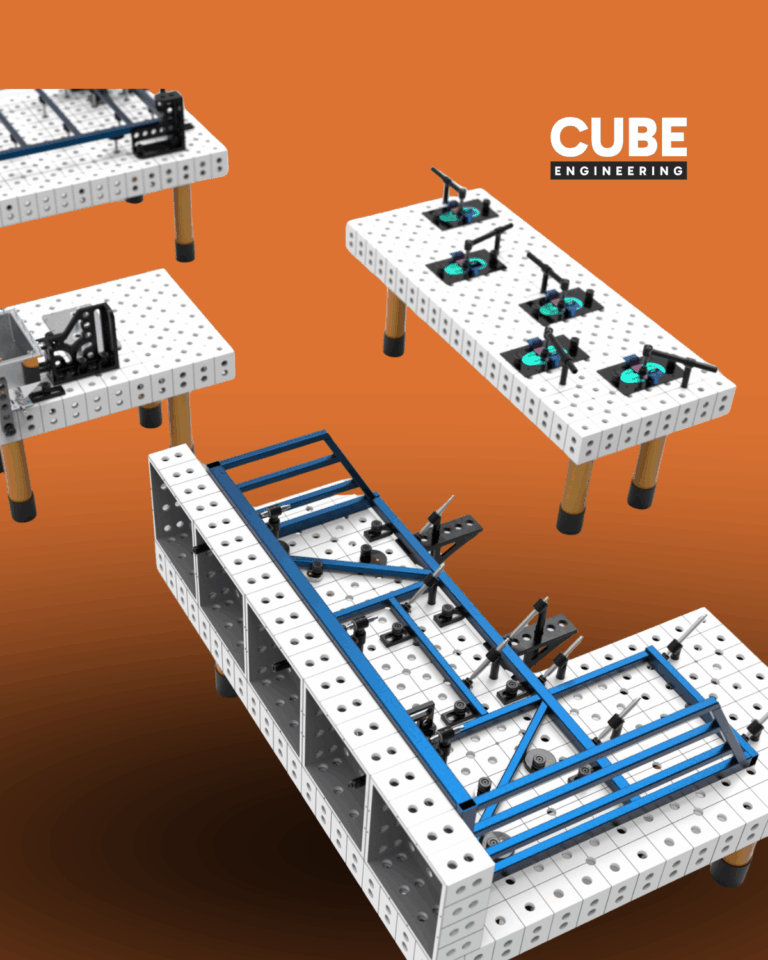
A larger working area offers more options when fabricating structures of different sizes. The modular design also allows the working area to be reconfigured, for example to 800 × 2400 mm or into an L- or T-shaped layout.
CUBEWELD ULTIMATE 28 2400 × 1200 mm + Tool Kit 2 – PLN 42,441 net
This solution is designed for users who need a large working area and a comprehensive set of clamping and positioning components.
Why does one welding table cost several times more than another?
At first glance, two tables may look similar: a metal top, system holes and legs. The differences become apparent in daily use.
1. The material used to make the table
A welding table operates in demanding conditions. It is exposed to high temperatures, impacts, welding spatter and intensive use. The material used therefore has a direct effect on both the price and the workstation’s durability. CUBEWELD tables use DURONEX 1200 steel, designed to provide excellent resistance of the working surface during intensive use.
2. Accuracy and flatness of the working surface
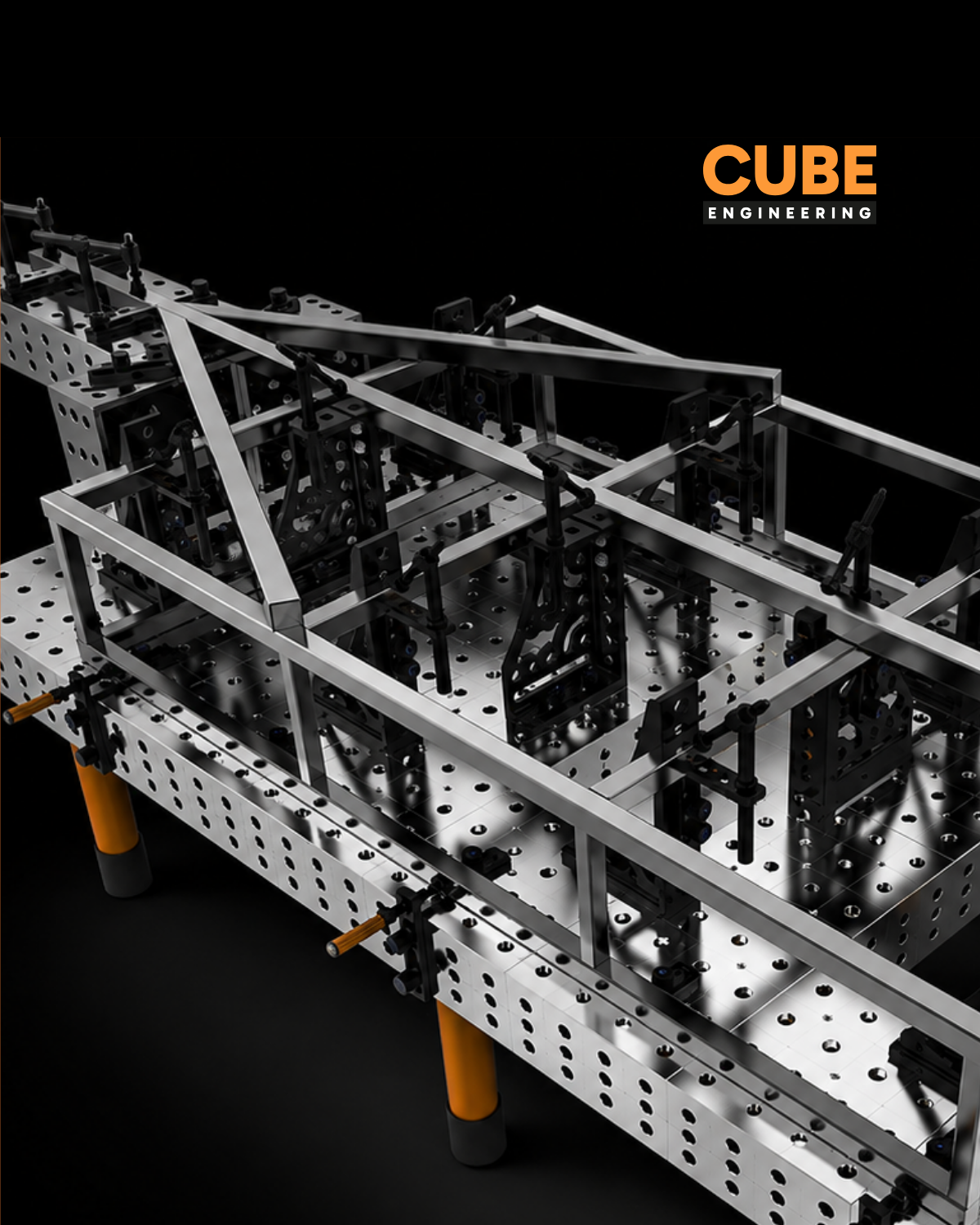
A welding table is not an ordinary worktop. It is the reference surface against which structural components are positioned. If the working surface does not retain the correct geometry, the problem can be transferred directly to the fabricated part. In practice, a highly accurate table helps reduce the time spent positioning, measuring and correcting components. When comparing offers, it is therefore worth checking not only the tabletop dimensions and thickness but also its flatness and dimensional-stability specifications.
3. Surface protection
The cost of a table also depends on the technologies used to increase the surface’s durability. The CUBEWELD system uses, among other things, DSR processes and NitriCorr, which are designed to increase the stability and durability of the system’s components. This is particularly important in plants where the workstation operates daily and for many hours.
4. Table size
The relationship is relatively simple: a larger working area requires more material and usually means a higher price. This does not mean that you should always buy the largest table available. If a company mainly fabricates small structures, an enormous table may take up valuable factory space unnecessarily and increase the investment cost. Conversely, a table that is too small can quickly become a constraint. This is where a modular welding-table design becomes particularly valuable.
A modular welding table: is it worth paying more?
A conventional table has fixed dimensions. Buy a 1200 × 800 mm tabletop and you receive a 1200 × 800 mm surface, usually with no scope to change it. A modular system works differently. CUBEWELD is based on 400 × 400 mm modules. These components can be joined both horizontally and vertically.
What does this mean in practice? You can start with a smaller workstation and, as requirements change:
– increase the working area,
– change its proportions,
– create a configuration tailored to a specific component,
– reuse system components in subsequent layouts,
– expand the workstation without replacing the entire solution.
When making a purchase, it is therefore worth analysing not only the welding table’s price but also the potential cost of adapting it to production in one, two or five years’ time.
A cheap or professional welding table: which offers better value?
It all depends on the application. If the table will be used only occasionally, for example for simple hobby projects, investing in a comprehensive industrial system may not make economic sense. The situation is different when the table forms part of a production process. The cost of the workstation should then be considered in relation to:
– component set-up time,
– clamping time,
– the number of components produced,
– the number of corrections and the table’s service life.
Imagine a workstation where an operator repeatedly positions similar components every day. If a better clamping system shortens each operation, the savings accumulate across every component and every subsequent shift. The cheapest welding table therefore does not always mean the lowest operating cost. In a production environment, the workstation’s total cost of ownership may be far more important.
How much do welding-table accessories cost?
This is another item that should be included in the budget. A tabletop alone does not make a complete workstation. Day-to-day work may require, among other things:
– clamps,
– stops,
– positioning components,
– angle brackets,
– pins and connecting components.
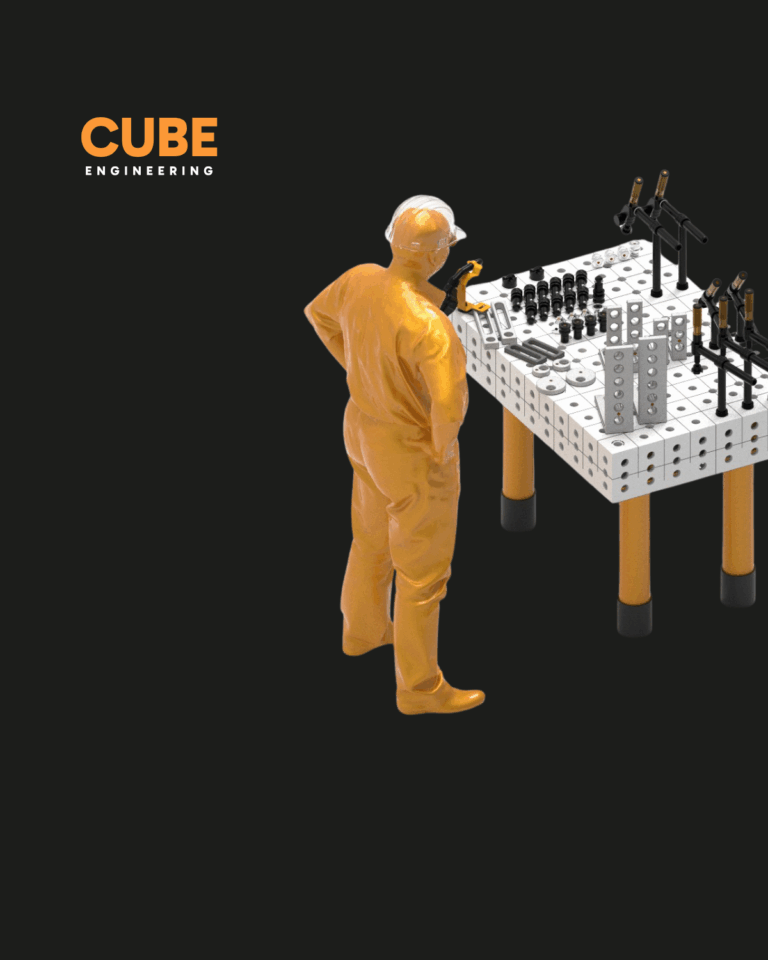
When comparing prices, it is therefore worth checking exactly what is included in the set. A cheaper table-only offer may prove less attractive once the equipment required to begin work is added. CUBEWELD offers both individual components and complete table sets with tool kits, allowing the equipment level to be matched to the workstation’s actual requirements.
What size welding table should you choose?
There is no single size that suits every plant. Before making a purchase, it is worth answering a few questions:
1. What are the typical dimensions of the components you fabricate?
2. How heavy are the welded structures?
3. Is production repetitive, or do you frequently undertake different jobs?
4. How much space can be allocated to the workstation?
5. How many operators will work at it?
6. Might the components produced in future be larger?
7. Will the workstation need to be changed over quickly?
Only then should you compare specific configurations and their prices. A compact workstation can be a good starting point for a small workshop. For series production or large structures, the priorities will be a larger area, a sufficient number of clamping points and rapid reconfiguration.
The table price is not everything. Calculate the workstation’s cost over time
Suppose a professional table costs more than a basic structure. The difference in purchase price is easy to see, but costs that arise later are less visible. These include:
– the time required to set up components each time,
– making additional assembly fixtures,
– corrections caused by incorrect positioning,
– downtime,
– replacement of worn components,
– the need to buy a larger table after the production profile changes.
Manufacturing companies should therefore treat a welding table as a tool that affects the productivity of the entire workstation, rather than as an ordinary item of equipment. A well-chosen system should not merely make fabrication possible; it should enable it to be completed as quickly, accurately and repeatably as possible.
CUBEWELD – a table that can change with your production
So how much does a good welding table cost? The final price depends on the workstation’s size, configuration and equipment. It is worth looking beyond the purchase cost alone. Durability, accuracy, working ergonomics, expandability and the table’s effect on production efficiency over the years ahead all matter too.
The CUBEWELD system was created for companies that do not want their workstation to be tied to a single tabletop size. Its modular construction allows the working area to be built and modified according to the current task and production requirements. A common hole system enables accessories to be used in different configurations, while solutions such as the DSR process, the NitriCorr process and DURONEX 1200 steel provide the characteristics required for intensive use. Buying a table therefore does not have to mean choosing one configuration for its entire service life.